Tools Tips and Tricks #4: RML Utilities

It is time again for your friendly neighborhood (or virtual neighborhood) SQL CSS person to provide you with the next set of tips for the various tools that he uses in his day-to-day work. I probably use this tool “RML Utilities” or the database created by this at least once a day and sometimes even more. Not kidding!!

This tool has become synonymous with Profiler Trace analysis collected from customer environments in CSS. Majority of you might be familiar with the tool “SQL Nexus” which call RML utilities in the background to load the collected Profiler Traces into a SQL Server database. This calls an executable, ReadTrace.exe. In this post, I will talk about a few conditions when you should be calling ReadTrace.exe instead of invoking it from SQL Nexus.

image

As you can see above that SQL Nexus provides you the option of breaking down the activity of each SPID into individual .trc files but they can only be directed to the %TEMP%\RML folder on your machine. The previous server that I had didn’t have sufficient disk space to hold over 100GB of data in the TEMP directory. Yes, we do analyze data which runs into a few hundred GBs at times!

Now you have two options, change the %TEMP% environment path on your machine to a different drive or use the ReadTrace.exe to generate the .trc files in the required path.

Another option that cannot be controlled from SQL Nexus is the ability to add SPID, Hostname and Application filters while importing the data.

Some of the defaults for ReadTrace are shown below which are required for any profiler trace import are:

-o Output files to be generated in the current directory
-S Connect to default SQL Server instance on the machine
-d Load profiler data into PerfAnalysis database
-E Use windows authentication while connection.

Here are a few scenarios where I use ReadTrace.exe directly….

Analyzing a deadlock scenario where I know the Session IDs involved

Sometimes the deadlock graph is not sufficient to figure out why a lock is still held by that session and why that session acquired the lock on the object in the first place. At that point, you need to track down the sequence of statements executed by the session. In this case, I will use the following command to import the data.

readtrace -S. -E -ddbRMLUtilDemo
-I"D:\RML\RMLUtil_demo.trc" -A"!SQLCMD" -s53 -s55 -MF -o"D:\RML\output" -f

The above command will import the trace files into a database dbRMLUtilDemo on the default instance on the machine with a SPID filter of 53 and 55 and exclude events generated with the application name SQLCMD. Additionally, individual .trc files will be generated containing the activity of SPIDs 53 and 55.

Generating .RML files to be used by OStress

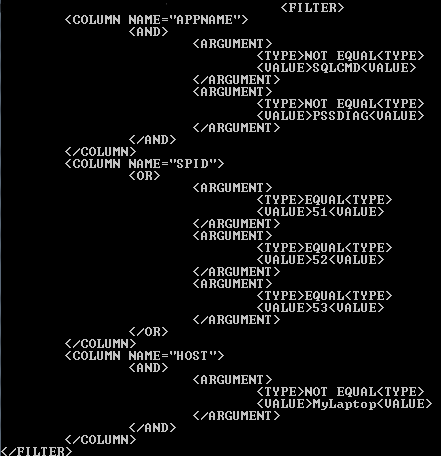
Use the –o parameter to change the output path and use the –s, –A and –H filters to apply the necessary SPID, application name and host name filters respectively. An example to apply filters for SPIDs 51, 52, 53, exclude events generated by application name PSSDIAG or hostname MyLaptop.

readtrace -S. -E -ddbRMLUtilDemo
-I"D:\RML\RMLUtil_demo.trc" -A"!SQLCMD" –s51 –s52 -s53 -o"D:\RML\output" –H"!MyLaptop" –A"!PSSDIAG"

The command line window and the ReadTrace.log file available in the output directory will confirm if the filters were applied correctly or not. Below is a screen shot of the command line window showing that the filters were applied correctly:
image

Handling MARS sessions

ReadTrace has limited processing ability for handling sessions using MARS (Multiple Active Result Sets). You have to use –f and –T35 to import data from trace files which contains MARS sessions. ReadTrace uses the formula ((Session Id * 10 ) + BatchId) so that a MARS sessions appears as a separate session. Eg. If you see Session ID 1620, 1621 and so on in the ReadTrace/SQLNexus database but cannot find such a session in the DMV outputs captured during that time, then the activity corresponds to Session ID 162 which was using MARS.

Note: And remember to always use a Server Side trace whenever possible to capture a profiler trace output to a local disk.

The PDF help files for RML Utilities are located at <system drive>:\Program Files\Microsoft Corporation\RMLUtils\Help folder by default on a machine where RML Utilities is installed in case you wanted more information on the above.

RML Utilities Download
http://blogs.msdn.com/b/psssql/archive/2008/11/12/cumulative-update-1-to-the-rml-utilities-for-microsoft-sql-server-released.aspx

Keep following the tag “Tools tips and Tricks” for more posts on the various tools that we use. That’s it for today!
Tools Tips and Tricks #3: Custom Rowsets using SQL Nexus

This post is part three of the Tools Tips and Tricks series that I started last week. In my T-SQL Tuesday post for this month, I already explained how I always have the inclination of importing data collected into a SQL Server database. I shall touch upon this yet again but this time through the use of SQL Nexus. I am going to use a small script to collect data for the user requests which are executing queries against a particular SQL Server instance. The script that I used to collect data is shown below:


set nocount on
go

while (1=1)
begin

print '-- RequestsRowset'

select GETDATE() as runtime,a.session_id as session_id,
a.start_time as start_time,
a.[status] as [status],
a.command as command,
a.database_id as database_id,
b.objectid
from sys.dm_exec_requests a
cross apply sys.dm_exec_sql_text(sql_handle) b
where session_id <> @@spid

raiserror ('', 0, 1) with nowait

waitfor delay '00:00:05'
end

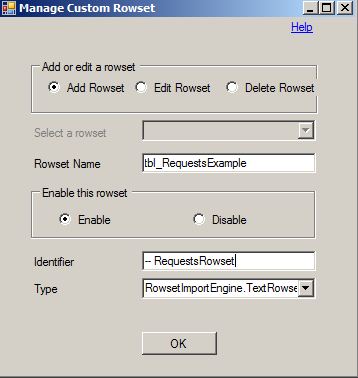
I have stored the output captured by the above query in a file called CustomRowset.OUT. Using the Edit Custom Rowset option in the SQL Nexus UI (available in the third expandable tab named Data, on the left hand side), I can pull up a UI where I can specify the table name into which the data needs to be imported into (tbl_RequestsExample in this case) and the identifier for the data which needs to be imported (— RequestsRowset in this case). I was executing a WAITFOR DELAY command from another session while the above script was capturing data. I then import the data into a SQL Nexus database using the Importoption. Once this is done, I can then query the database and look into the results which were imported into the database. (see screenshot below). You can extend this functionality to any degree you want and even combine multiple T-SQL commands to capture different result sets in the same loop. You just need to make sure that the rowset identifier for each query result set is unique.

Additionally, if you attempt to capture outputs which have columns with data type length greater than 8000, then the import will fail with the following error in the SQL Nexus log file:

SQLNexus Information: 0 : RowsetImportEngine Error: An unexpected error has occurred:

System.Data.SqlClient.SqlException: The size (8192) given to the column ‘query_text’ exceeds the maximum allowed for any data type (8000).

SQL Nexus 3.0 doesn’t give you the option to add your own column data types using the UI.  Using the form (shown on the left) will treat all columns as varchar. If you want to change this behavior, then modify C:\Users\<user name>\AppData\Roaming\sqlnexus\TextRowsetsCustom.xml directly to add or modify the data types that you want.

Where is this helpful?
Let’s say I decided to collect the output of customized T-SQL script for an extended period of time. Instead of scouring the .txt or .out file manually using a text editor, I can import the data into a table and then run queries on them to save yourself a hair-raising experience and valuable time!

How do I make sure that the data is imported correctly?
1. If you have data which is larger than varchar(8000) in the result sets collected, then make sure to modify the TextRowsetsCustom.xml before you import the data.
2. Give each rowset that you collect an unique identifier. You don’t want the importer to mix-n-match the data you are importing.
3. Add a runtime column using GETDATE() or a variable for scripts capturing data in a loop to ensure that you can track the trend easily without having to second-guess.
4. All columns that are collected in the result set(s) have to be named.
5. Avoid CR/LFs in the result set i.e. don’t use CHAR(13) in your T-SQL script while capturing the data as this seriously confuses the importer as it treats CR/LFs as end-of-row indicator.
6. Either capture the data directly into a file by running the data collection script from Management Studio or use sqlcmd -W parameter if you are capturing the data using sqlcmd. -W ensures that trailing spaces from the result sets are removed.

That is all I have for today. Happy customizing and importing!

Tools Tips and Tricks #2: SQL Express RANU instances

Recently I had worked on an issue with Run As User Instances a.k.a. RANU. The user instance, also known as a child or client instance, is an instance of SQL Server that is generated by the parent instance (the primary instance running as a service, such as SQL Express edition) on behalf of a user. The user instance runs as a user process under the security context of that user. The user instance is isolated from the parent instance and any other user instances running on the machine. The user instance feature is also referred to as “Run As Normal User” (RANU). This is not a feature of SQL Server that is common knowledge to most people in the SQL realm. Note the following mention in BOL for the topic “User Instances for Non-Administrators”:

This feature will be removed in a future version of Microsoft SQL Server. Avoid using this feature in new development work, and plan to modify applications that currently use this feature.

Why did I decide to talk about a SQL Server feature in a series that I am running on my blog related to tools. Well, this post is about connecting to a RANU instance and the tools available to do this. But this is a lesser known beast, I had to set some context first. Smile

User instances are created when the “User Instance option” is set in the SQL Client connection string. Following is a section of a Visual Basic configuration file that shows the User Instance option:

<connectionStrings>
<add name=”TestVB1.Settings.Database1ConnectionString” connectionString=”Data Source=.\SQLEXPRESS; AttachDbFilename=|DataDirectory|\Database1.mdf; Integrated Security=True; User Instance=True” providerName=”System.Data.SqlClient” />
</connectionStrings>

How can I find out if there are RANU/User Instances running on the machine?

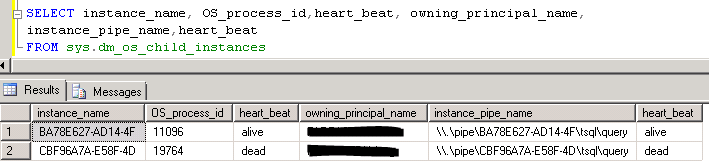
On the SQLEXPRESS instance, the configuration option “user instances enabled” in should be enabled. Then execute the query shown in the screenshot below against the SQLEXPRESS instance:

image

The heart_beat column value will tell you is the instance is online or not. For an online instance, the heart_beat will have a value set to alive. RANU instances allow only local Named Pipe connections. So there are three ways how you can connect to a RANU instance:

1. Using Management Studio

image

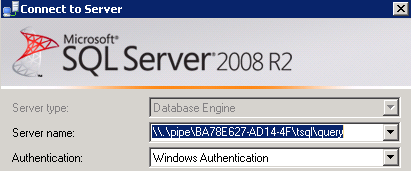
a. Launch a Management Studio on the machine where the SQL Express instance is running.
b. In the Connect to Server dialog box, you will have to specify the instance_pipe_name value obtained from the above output as the Server Name.

2. Using SQLCMD

Using the sqlcmd utility, you can also connect using the pipe name in the following manner:

sqlcmd -Snp:\\.\pipe\BA78E627-AD14-4F\tsql\query -E

3. Using SQL Server Express Utility

This is a utility available on the Microsoft Downloads site but is not supported by CSS. One of the tasks that can be performed by this utility is to connect to User Instances. The SSEUtil.exe –childlist command will list all the RANU instances on the machine. The output is the same as the one shown above which was retrieved using sys.dm_os_child_instances. Refer screenshot below.

image

The ReadMe.htm available with the installation of the utility has information on what can be done with this utility other than connecting to a user instance.

You can then connect to the instance using the following command:

SSEUtil.exe -c –child <domain>\<user name>

How do I shutdown a RANU/User Instance?

A RANU instance has a defined timeout value of 60 minutes; after 60 minutes without activity, RANU shuts itself down. The RANU timeout is configurable at the parent instances through the ‘User Instance Timeout’ setting. If you want to shutdown a RANU instance before the timeout is reached, then you can use one of the methods listed above to connect to the User Instance and issue the following command:

SHUTDOWN WITH NOWAIT

References:
Understanding SQL Express behavior: Idle time resource usage, AUTO_CLOSE and User Instances
Connecting to SQL Express User Instances in Management Studio

Now it’s time to shutdown this post… Adieu till the next post.

DBREINDEX and ALTER INDEX differences

I had written about update statistics a long time back and had been meaning to write a clarification on the difference in behavior w.r.t. table statistics being updated when rebuilding indexes using different T-SQL commands. I am sure all of you are aware of why statistics for a table need to be updated with a fullscan to ensure that the optimizer doesn’t fall prey to sub-optimal plans. However, there is a little known fact about how statistics get affected when a DBREINDEX is issued on a table versus an ALTER INDEX…REBUILD ALL.

I created a table with 4 integer columns and inserted 100,000 records into the table using the script below:

-- Create table
create table tblUpdStats (a int primary key,b int,c int, d int)
-- Insert 100,000 rows in the table
set nocount on
declare @var int = 1
while @var<=100000
begin
insert into tblUpdStats values(@var,@var+1,@var+2,@var+3)
set @var+=1
end
-- Create a non-clustered index on column b
create index idx_b on tblUpdStats(b)
-- Create a user-defined statistics on column c
create statistics stat_c on tblUpdStats(c)
-- Execute the following to query so that the database engine creates an auto-created stats on column d
select d from tblUpdStats where d > 50000
Name                            Updated              Rows    Rows Sampled
------------------------------- -------------------- ------- ------------
idx_b                           May 13 2011  8:03PM  100000  100000
PK__tblUpdSt__3BD0198E558AAF1E  May 13 2011  8:03PM  100000  100000
stat_c                          May 13 2011  8:03PM  100000  100000
_WA_Sys_00000004_53A266AC       May 13 2011  8:03PM  100000  100000

I took a snapshot of the DBCC SHOW_STATISTICS output for the statistics associated with the non-clustered index, clustered index, user created statistics and auto-created statistics. All the rows and rows sampled are equal which means that the statistics are updated with a fullscan. I then inserted another 100,000 rows into the same table. I then executed the following command to rebuild the indexes on the table:

alter index all on tblstats rebuild

I took a snapshot of the DBCC SHOW_STATISTICS command again and notice the difference below:

Name                            Updated              Rows     Rows Sampled
--------------------------------------------------------------------------
idx_b                           May 13 2011  8:19PM  200000   200000
PK__tblUpdSt__3BD0198E558AAF1E  May 13 2011  8:19PM  200000   200000
stat_c                          May 13 2011  8:03PM  100000   100000
_WA_Sys_00000004_53A266AC       May 13 2011  8:03PM  100000   100000

You will see that the user created and auto-created statistics do not reflect the change in the number of rows. However when I execute a DBREINDEX on the table, I see a different picture altogether. (See show_statistics output below)

dbcc dbreindex ('tblUpdStats','')
Name                               Updated              Rows      Rows Sampled
 ---------------------------------- -------------------- --------- --------------
 idx_b                              May 13 2011  8:31PM  200000    200000
 PK__tblUpdSt__3BD0198E558AAF1E     May 13 2011  8:31PM  200000    200000
 stat_c                             May 13 2011  8:31PM  200000    200000
_WA_Sys_00000004_53A266AC           May 13 2011  8:31PM  200000    200000

Now if I look at the rows sampled and rows column values, I see that the updated column shows the same date for all the objects. In this case the rows sampled and rows are the same indicating that a fullscan occurred for the user created/auto created statistics on the table.

To summarize, ALTER INDEX…REBUILD ALL will not update statistics which were manually created or were auto-created by the Database Engine. It will only update statistics associated with the indexes defined on the table columns. On the other hand, a DBCC DBREINDEX on the table will update statistics for the user created statistics and the auto-created statistics using the default sampling rate. The default sampling comes into play for very large tables. If you have a maintenance plan job which does an index rebuild operation on SQL Server 2005 or above, then that uses an ALTER INDEX…REBUILD command.

Tools Tips and Tricks #1: Process Monitor

I recently wrote about importing a Process Monitor trace into SQL Server database table and crunch up the data to extract the events and call stacks. This prompted me to think about capturing data with Process Monitor and some things I learnt along way while using this tool working at CSS.

imageThe first tip is to disable any activity that you don’t want to capture or are not required for the issue that you are troubleshooting. The capture tracks three classes of operations: File System, Registry and Process. In the toolbar show on the left in the screenshot, you can enable/disable the following captures:

a. Registry activity
b. File System activity
c. Network activity
d. Process and Thread activity
e. Profiling events

More information about the above is available in the Process Monitor help file. image

The command line options specified are immensely helpful if you are scripting the capture of a trace using a batch file or if you are generating an automation routine to load the captured data into another data source. I had used /OpenLog and /SaveAs1 option to generate the XML file from the saved .PML file.

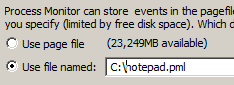
imageOne of the most useful options that I suggest using when capturing a Process Monitor trace is to use the backing file option (/BackingFile command line parameter or CTRL+B when using the GUI). This prevents using the page file as the backing store for trace capture and avoid running in unresponsive server issues while you are still capturing your trace and the paging file fills up. I normally point the backing file to a local drive on the machine which has sufficient amount of disk space.image

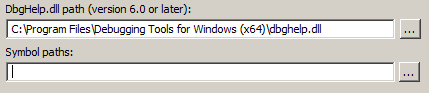
Process Monitor can use symbol information, if available, to show functions referenced on event stacks. You can point to the symbol path (local symbol cache or Microsoft Symbol Server: http://msdl.microsoft.com/download/symbols) using Options –> Configure Symbols. Additionally, you can specify the path to the source files for the application in the same dialog. This will help you resolve the function calls using the symbol path and if a source path is present, open a text viewer dialog with the source line highlighted which is being referenced. The symbol path is needed when /SaveAs2 option is used for converting the .PML file to .XML format. Note that this option considerably increases the export time due to symbol resolution time involved.

I am starting a series tagged with “Tools Tips and Tricks” which will document the various tweaks that I use for data collection for the various data collection/analysis tools that I use on a day-to-day basic.